Free · Grades 3–8
Be Outside Experience · Cache Valley, Utah

Trail Walk

Walk the trail to Birch Creek in Smithfield, Utah, from anywhere. A short film, four lessons in noticing, wondering, and making connections, two leveled readings, and everything you need to send kids outside to create. Free for teachers and parents.

Land Acknowledgement

The trails we walk in Cache Valley are the homeland of the Northwestern Band of the Shoshone Nation, who are still here today. We remember that this land was taken from them through violence. As we walk, we honor their history and care for this land.

Step One · Watch

Bring the trail into your room.

Watch the film once, just to take it in. Then watch again with a foldable in hand, pausing on anything that deserves a closer look. Willows, a 200-year-old juniper, a rose that smells like apples, and a creek at the end of the trail.

The film is on its way. Check back soon, or download the guide below to get started.
Arrive

Quick breathwork to check in before you begin.

Watch

Watch the film once, just to take it in.

Watch to Learn

Watch again and fill out the foldable.

Reflect

Journal how you feel and what you learned.

Go Outside & Create

Make art, photos, or film wherever you are.

Share

Show your project to peers, a teacher, and a parent.

Four Lessons · Grades 3–8

Notice. Wonder. Connect.
Then go outside.

Each lesson opens with a short breathing practice, revisits the film, and builds one nature journaling skill. Teach them on four days, or fold them into a single afternoon.

1
I Notice…

Students learn to look closely, look from new angles, and take their time with nature.

I Notice foldable: notice, draw, and label 2 different plants or trees.

2
I Wonder…

Students turn what they noticed into questions, then use a leveled reading to find answers.

I Wonder foldable: write 5 questions, then answer what you can from the reading.

3
It Reminds Me Of…

Students connect what they saw on the trail to places, people, and memories in their own lives.

It Reminds Me Of foldable: write or draw 3 connections to your own life.

4
Be Outside!

Students reflect in a nature journal, then head outside to make something of their own.

Final project: 3 labeled details, 3 questions, and 1 connection.

Every lesson plan follows the same simple structure: learning outcomes, a Breathe & Arrive practice, content presentation, learner participation, assessment, and follow-up activities.

Utah Core Standards · CASEL

Standards taught

Trail Walk is built for Utah classrooms and for the whole student. See which Utah Core Standards and CASEL social-emotional competencies each lesson addresses.

Show standardsHide standards

Open a subject to see the details. Standards marked Supports are touched on but not fully covered, so pair them with your own instruction.

Science (SEEd)Utah Science with Engineering Education · Grades 3–8
StandardWhat students do in Trail WalkLesson
3.2.5Grade 3Some organisms survive well in a habitat, some less well, and some not at all. Willows and cottonwoods crowd the creek; junipers grow on dry, rocky hills.2
4.1.1Grade 4Plant structures support survival, growth, and reproduction. Students draw and label plant parts, then read about deep sagebrush roots and the juniper's berry-like cones.1, 2
5.3.3Grade 5Matter moves among plants, animals, decomposers, and the environment. The old decaying tree feeds insects and fungi and slowly becomes soil.2
6.4.1Grade 6Resource availability affects organisms. Water decides where willows and cottonwoods can grow along the creek.2
6.4.2Grade 6Patterns of interaction among organisms. Monarchs depend on milkweed; birds feed on juniper cones in fall and winter.2
6.4.3Grade 6Producers, consumers, and decomposers. Insects, fungi, and birds at work on the decaying tree.2
6.4.5Grade 6Preserving biodiversity, including responses to invasive species. Native vs. introduced plants, and the "Read the Land" question about which plants are winning. Supports2
7.4.2Grade 7Plant structures that affect reproductive success. Cottonwood seeds float away on fluffy fibers; birds spread St. Lucie cherry seeds into Utah's valleys.2
8.3.3Grade 8Ask questions about how ecosystem changes affect matter cycling. Students write their own questions, including about the decaying tree. Supports2

Every lesson also builds the SEEd practice of asking questions and obtaining, evaluating, and communicating information through observation, drawing, and the Field Read.

English Language ArtsUtah ELA Standards (2023) · Grades 3–8
StandardWhat students do in Trail WalkLesson
R.53.R.5 – 7–8.R.5Ask and answer questions, referring to the text. Students answer their own I Wonder questions with evidence from the Field Read.2
R.63.R.6 – 7–8.R.6Determine the main idea and how key details support it. Old neighbors vs. newcomers, and how to tell them apart.2
R.83.R.8 – 7–8.R.8Determine the meaning of academic and content-specific words. Words to Know: native, introduced, poplar, graft, pemmican.2
W.23.W.2 – 7–8.W.2Write informative pieces that convey ideas clearly. Labeled drawings and written descriptions of what students observe. Supports1, 4
W.43.W.4 – 7–8.W.4Conduct short research projects. Students research a question the reading didn't answer.2 (follow-up)
SL.13.SL.1 – 7–8.SL.1Participate in conversations and collaborations. Partner sharing of personal connections.3
SL.33.SL.3 – 7–8.SL.3Speak and present clearly. Students present their outdoor project to peers, a teacher, and a parent.4 (Share)

Utah's ELA standards use the same numbers at every grade (for example, 3.R.5, 4.R.5, 5.R.5, 6.R.5, 7–8.R.5), so each row applies across Grades 3–8 at grade-level rigor.

Social StudiesUtah Social Studies · Grade 4 and Utah Studies
StandardWhat students do in Trail WalkLesson
4.1.2Grade 4How and why humans changed Utah's environment to meet their needs. Smooth brome planted for livestock; St. Lucie cherry escaping from orchards.2
4.2.3Grade 4Ways of life of Native American tribal groups. Shoshone uses of willow and chokecherry, and the name Sihiviogoi, "Willow River." Supports2
Utah Studies 1.2Grade 7Interactions between Utah's physical characteristics and American Indian cultures. How the Northwestern Band of the Shoshone used the plants of Cache Valley for baskets, windbreaks, and pemmican.2 + land acknowledgement
HealthMental and Emotional Health · Grade 3, Grade 6, Health I
StandardWhat students do in Trail WalkLesson
3.MEH.2Grade 3Identify ways to relieve stress. The Trail Breath opens every lesson, and One Last Breath closes the guide.1–4
6.MEH.2Grade 6Practice stress-management techniques, including mindfulness and guided imagery. Students picture an outdoor place that matters to them.1–4
HI.MEH.1Health IExplore stress-management techniques such as breathing exercises and guided imagery.1–4
Visual ArtsUtah Fine Arts Standards · Grades 3 and 6
StandardWhat students do in Trail WalkLesson
3.V.CO.1Grade 3Develop a work of art based on observations of surroundings. Students go outside and create from what they notice.4
3.V.CR.2Grade 3Create a personally satisfying artwork using a variety of processes and materials. Watercolor, pencil, markers, or photography.4
6.V.CR.2Grade 6Investigate personally relevant content for creating art. Students build their project from their own connections to the land.3, 4
Social-Emotional Learning (CASEL)CASEL 5 core competencies · Grades 3–8
CompetencyWhat students do in Trail WalkLesson
Self-AwarenessUnderstand one's own emotions, thoughts, and values. Students check in with how they feel before each lesson, journal how they feel afterward, and connect the trail to places and memories that matter to them.1–4
Self-ManagementManage emotions and stress, and work toward goals. The Trail Breath calms and focuses students at the start of every lesson; the final project sets a clear goal of 3 details, 3 questions, and 1 connection.1–4
Social AwarenessUnderstand others' perspectives, including those from diverse backgrounds. The land acknowledgement and Field Read center the Northwestern Band of the Shoshone; students ask a family member about a place that matters to them.2, 3 + land acknowledgement
Relationship SkillsCommunicate clearly, listen, and work with others. Partner sharing, presenting projects to peers and adults, and reading the poem for two voices together.3, 4
Responsible Decision-MakingMake caring, constructive choices and weigh consequences. "Read the Land" asks what happens if introduced plants keep spreading; students learn trail safety and to take only pictures and leave no trace.2, 4

CASEL's framework describes competencies rather than numbered grade-level standards. Utah's Health standards above cover the related stress-management skills.

Aligned to the current Utah Core Standards from the Utah State Board of Education and the CASEL framework. Check with your district for local pacing and course requirements.

Field Reads · Two Reading Levels

Old Neighbors and Newcomers

Who grows on this trail, and how did it get there? Two double-sided readings help students sort the trail's native plants from the newcomers people brought from far away, and answer the questions they raised in Lesson 2.

Grade 3
Old Neighbors and Newcomers

Short, clear sentences about willows, chokecherries, a 200-year-old juniper, and a rose that smells like apples. Includes Trail Facts and Words to Know.

Grades 6–8
Old Neighbors and Newcomers

A deeper look at native and introduced plants, Shoshone uses of willow and chokecherry, and how one escaped orchard tree spread across Utah's valleys. Ends with a Read the Land question.

Old Neighbors (Native)

Willow · Chokecherry · Utah juniper · Milkweed · Big sagebrush · Maple · Aspen · Narrowleaf cottonwood

Newcomers (Introduced)

Sweet-briar rose · St. Lucie cherry · Smooth brome

See an Example

What a nature journal entry looks like.

Stu's own entry from the Birch Canyon Connection Trail, June 2026. Show it to students after they've started their own, so they can see each part in action.
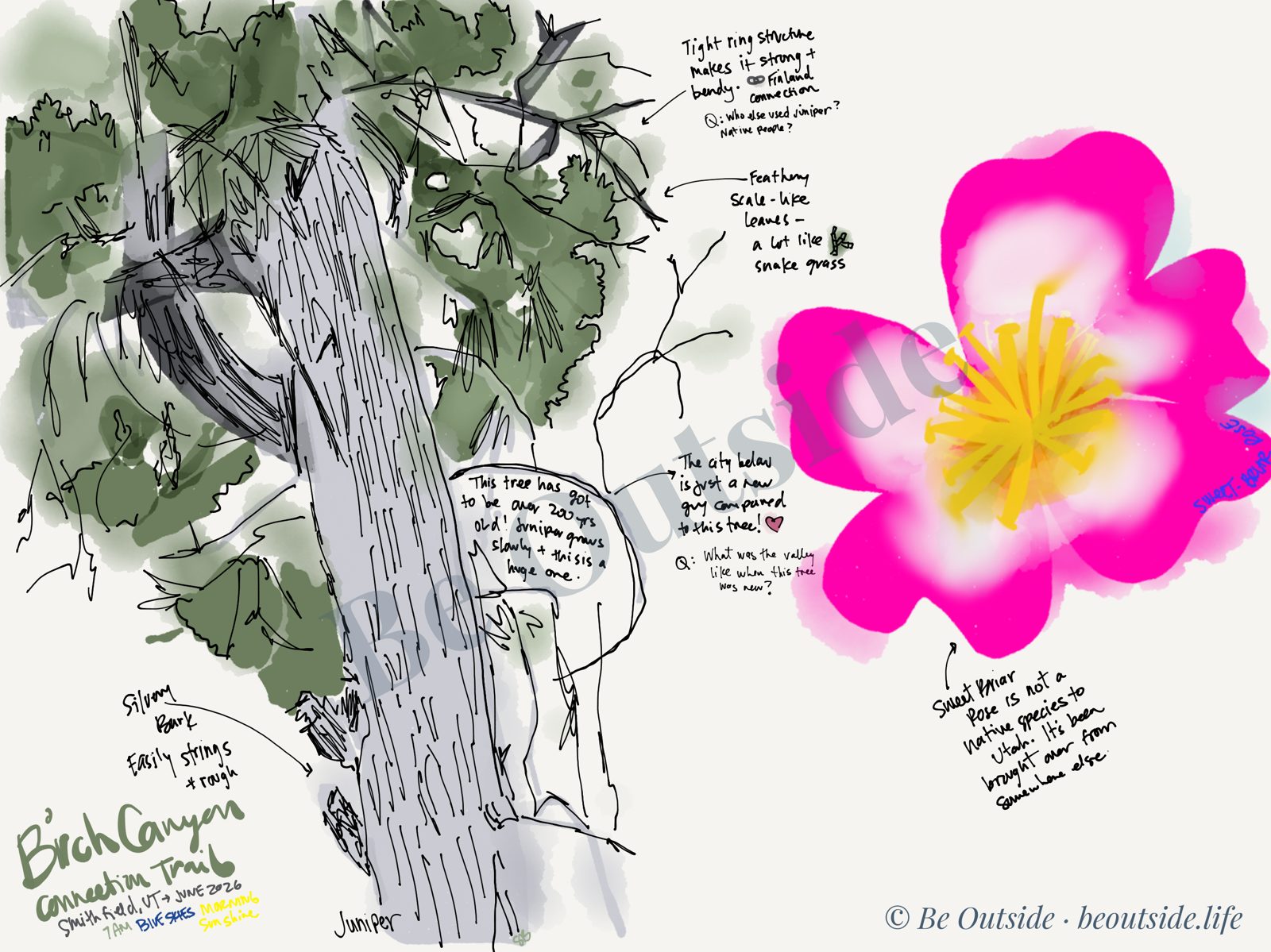
Stu's nature journal entry: a sketch of a 200-year-old juniper with labeled bark and leaves, and a pink sweet-briar rose, with handwritten notes and questions
  • Labeled detailsSilvery bark that strings easily, feathery scale-like leaves, and a tight ring structure.
  • QuestionsWho else used juniper? What was the valley like when this tree was new?
  • ConnectionsThe leaves look like snake grass, and the city below is "just a new guy" compared to this tree.
  • HeaderThe place, date, time, and weather.
Free Downloads

Everything you need,
ready to print.

Download the whole guide, or just the pieces you need for today.

Trail Walk: Complete Field Experience Guide

All four lessons, the foldables, both Field Reads, the Nature Journal page, an example entry, and a bonus poem for two voices. PDF.

Download the Full Guide
A Note to Teachers and Parents

Teaching and parenting are hard. Be Outside wants to help, with lessons built to calm and regulate kids and give you a minute to slow down too. And don't let a lesson be your only trail. Find a hike near you and get lost in nature for an afternoon. Everything will still be waiting for you when you get back.

— Stu Baggaley, Be Outside

🌬️ One Last Breath

  1. Rest one hand on your heart and the other on your belly.
  2. Breathe in slowly and let your belly fill. Watch your hand rise.
  3. Keep breathing in, letting the air rise into your chest.
  4. Sip in one last little breath, up to your collarbones.
  5. Pause at the top.
  6. Exhale and let it all go. Soften your jaw and drop your shoulders.
  7. Notice how you feel.
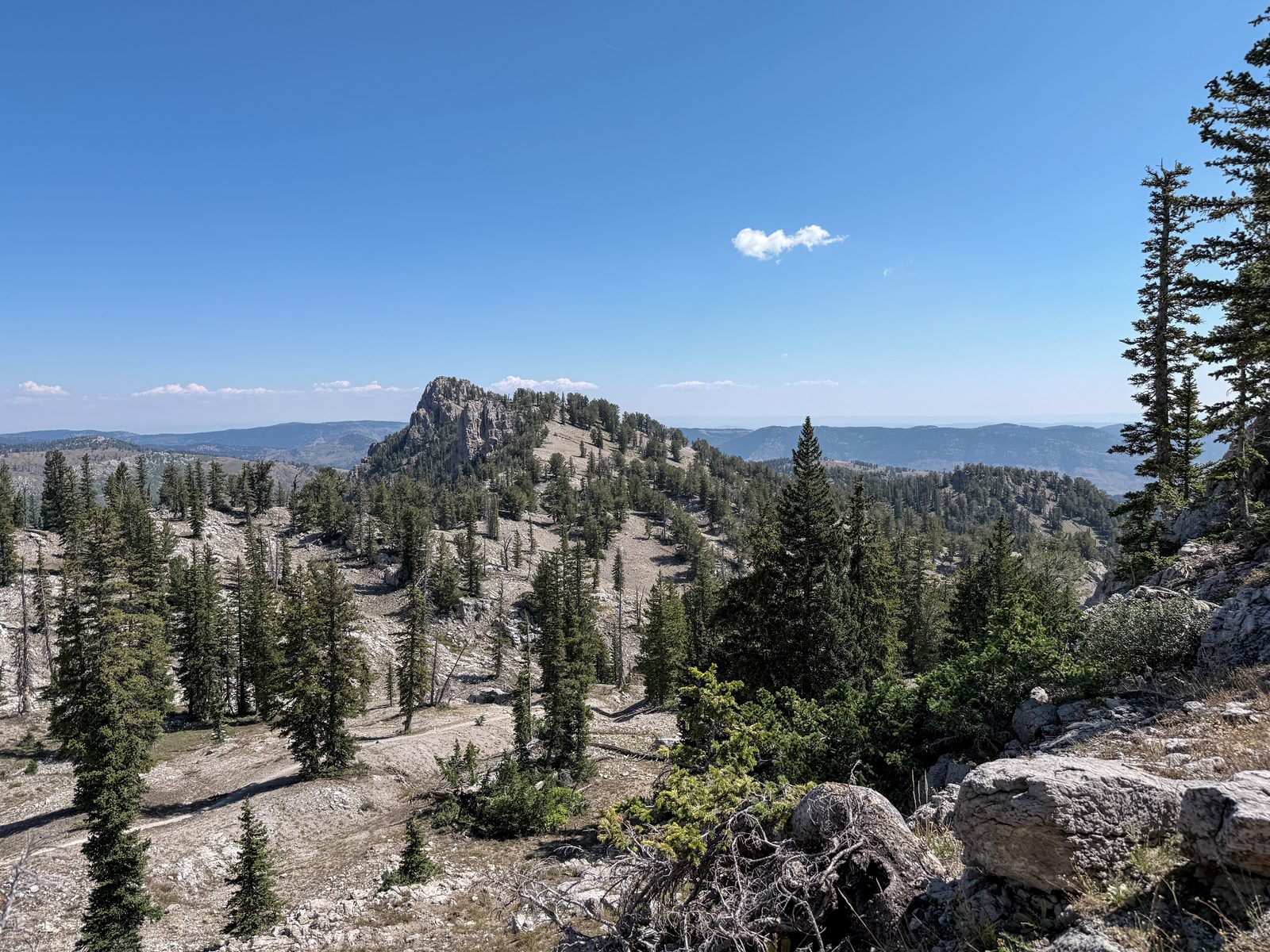
View from the Mt. Naomi trail in the Bear River Range
Keep Exploring

More trails are on the way.

Mt. Naomi and the San Juan River are next. Want a heads-up when they're ready, or an experience built around your own place?